A keyboard · HHKB layout · analog · 305 × 115 mm
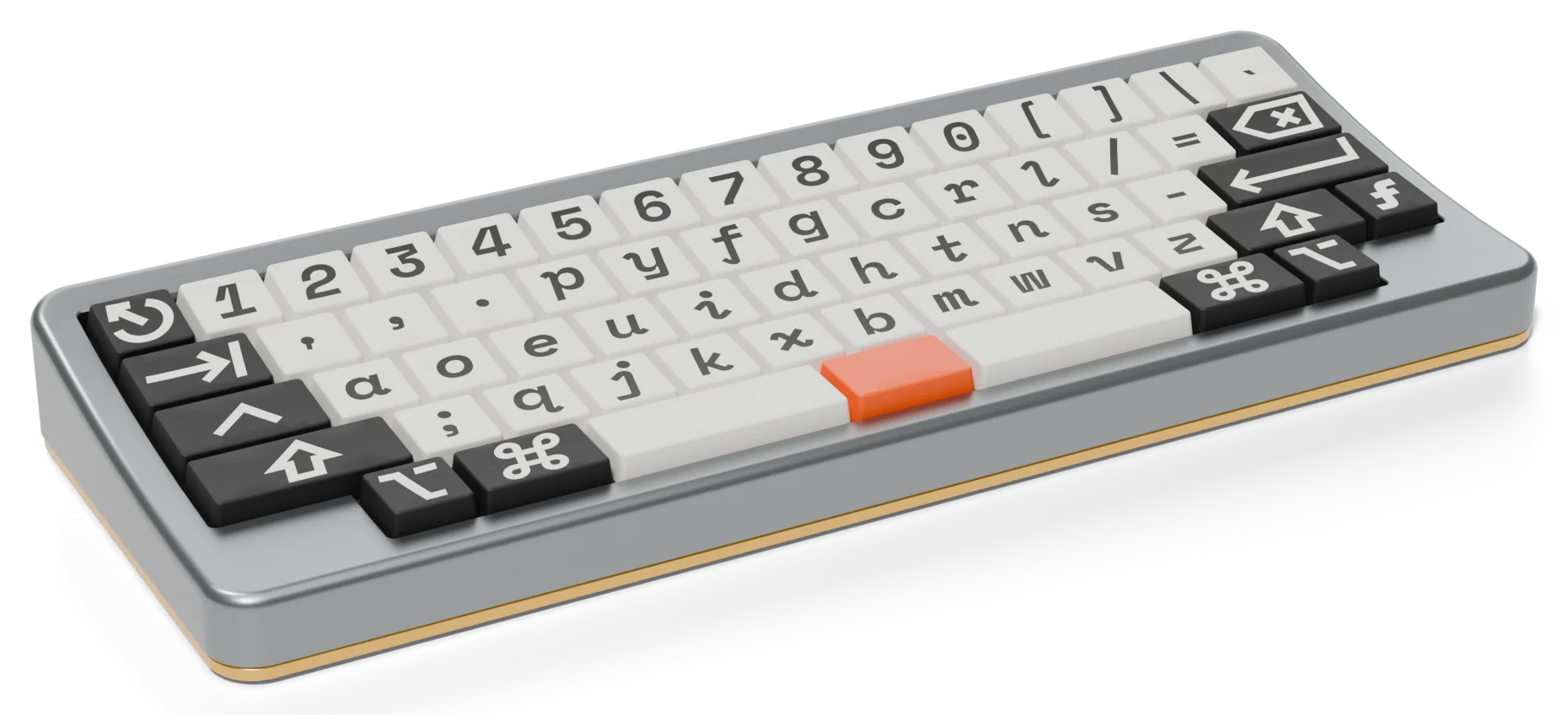
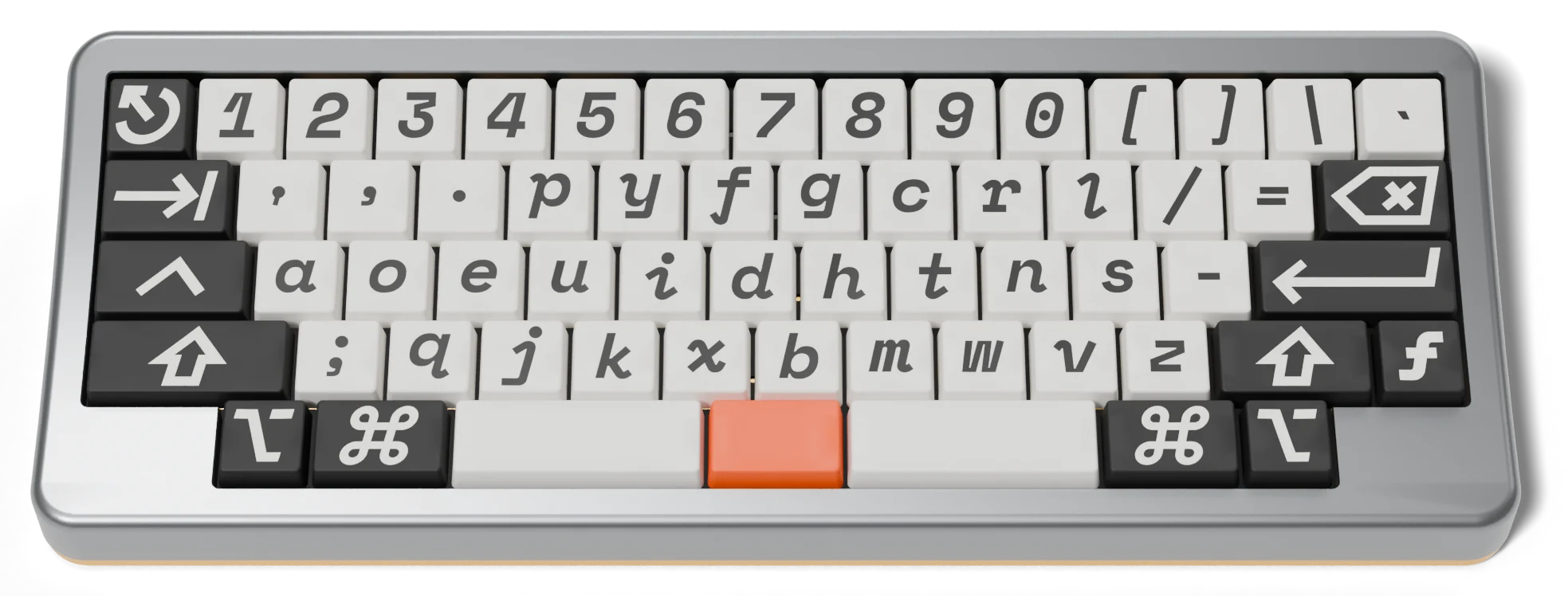
Sixty-two keys in a shallow gully.
An HHKB-layout keyboard whose rows curve: each turns 3° from the next, so together they make a trough your fingers sweep across. Under every key, a sensor reads how far down it is. And on every letter, its Dvorak name, huge.
Scroll. Or type, or run the mouse across its keys. Drag to spin it
01 · The curve
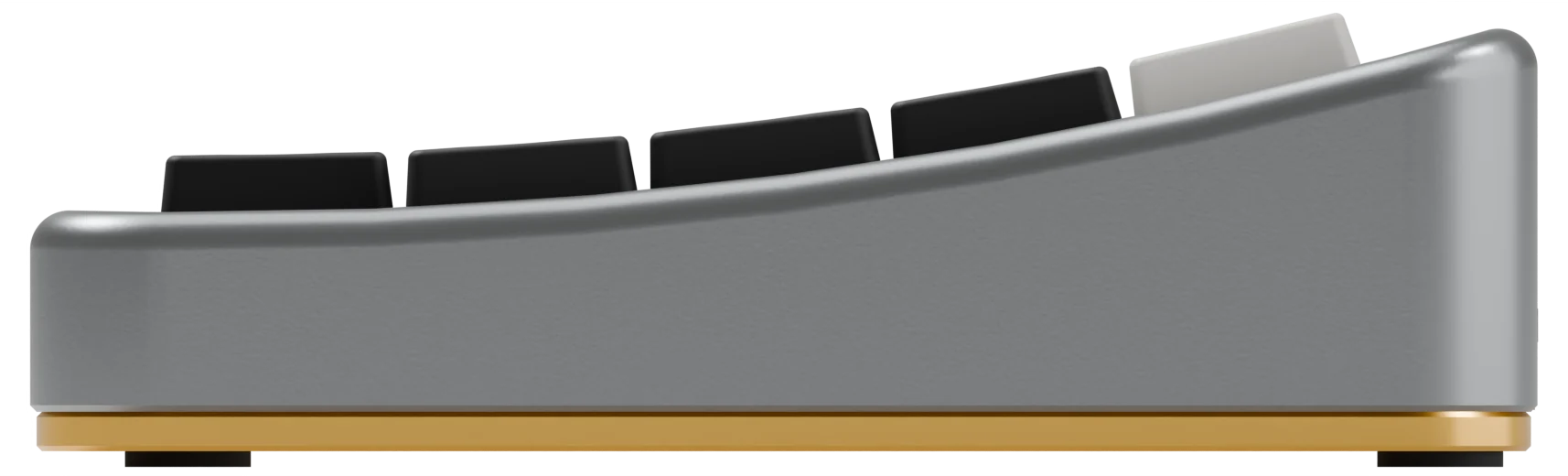
Every row turns 3° from the next.
Keyboards are flat because a circuit board can't bend. Here the plate does: one sheet of aluminium, bent four times between the rows, with a board of its own under each row. The bottom row sits at 1° to the desk and the number row at 13°.
So every key presses square to its own row. The far rows travel toward your hand rather than straight down, and the number row tips toward you: nearer, without being any smaller. The curve does the sculpting a keycap set usually does, so every cap is the same shape.
Down the gully
Five rows, one long valley. The keys part as you go.
02 · Analog
Every key knows how far.
The switches are Hall effect: a magnet in each stem, and a sensor under it on the board that reads where the magnet is through the whole 4 mm of travel. Nothing touches and nothing's soldered, so any MX-stemmed magnetic switch goes in from the top: Wooting's Lekkers, Gateron's Jades, the tactile ones.
- Where it trips
Each key sets its own actuation point, from a brush to a bottom-out.
- When it lets go
Rapid trigger: a key resets the moment it starts back up, not at a fixed line.
- What else
Still to choose. The favourite: hold a chord and the keys are an instrument, how deep and how fast sent as MIDI.
The firmware will be open: libhmk, ported to the house's chip, the RP2350. So it's yours to rewrite.
03 · Inside
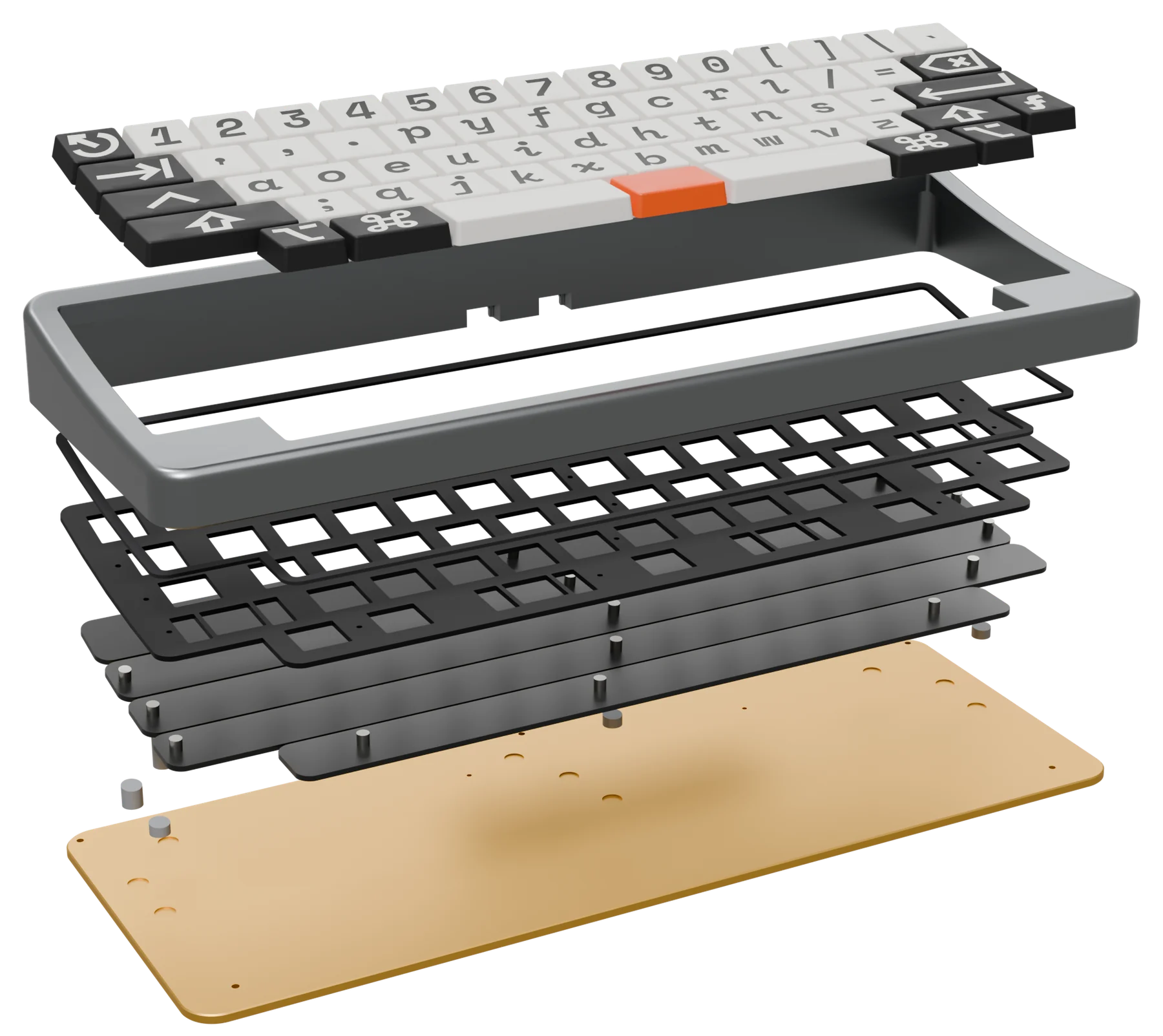
Cut from above and below, and nothing on a slant.
- CapsPrinted resin, one shape in five widths.
- SwitchesAny Hall-effect MX switch, in from the top. Drawn here as stand-ins.
- BodyOne piece of 6061, every face square to the desk: three-axis work.
- GasketPoron, under the deck. No screw goes into the plate.
- Plate1.5 mm 5052, bent four times. All the angles are in here.
- BoardsOne a row, hanging from the plate on standoffs.
- SpacersThey press it all up into the gasket. The hub's here too.
- Base3 mm brass.
04 · Underneath
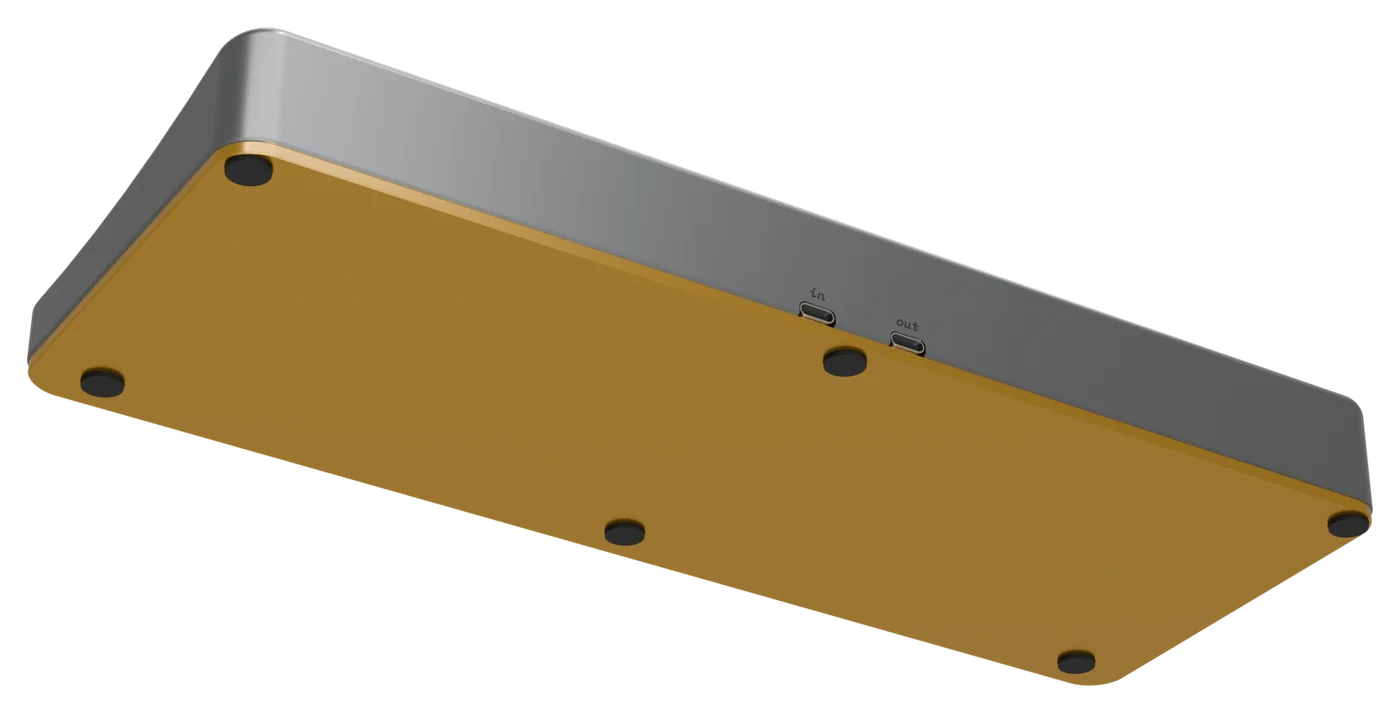
Brass, and no screws to see.
A 3 mm brass base, half a millimetre inside the body all round, so the foot shows a shadow line and a line of brass. Its five screws hide under the feet.
At the back, two slim USB-C slots, cut close round their sockets and resting on the brass: one in from the computer and one out, as the HHKB Pro 2 had, a hub for a security key or a dongle. Their marks are lasered on, in the house's face.
05 · The boards
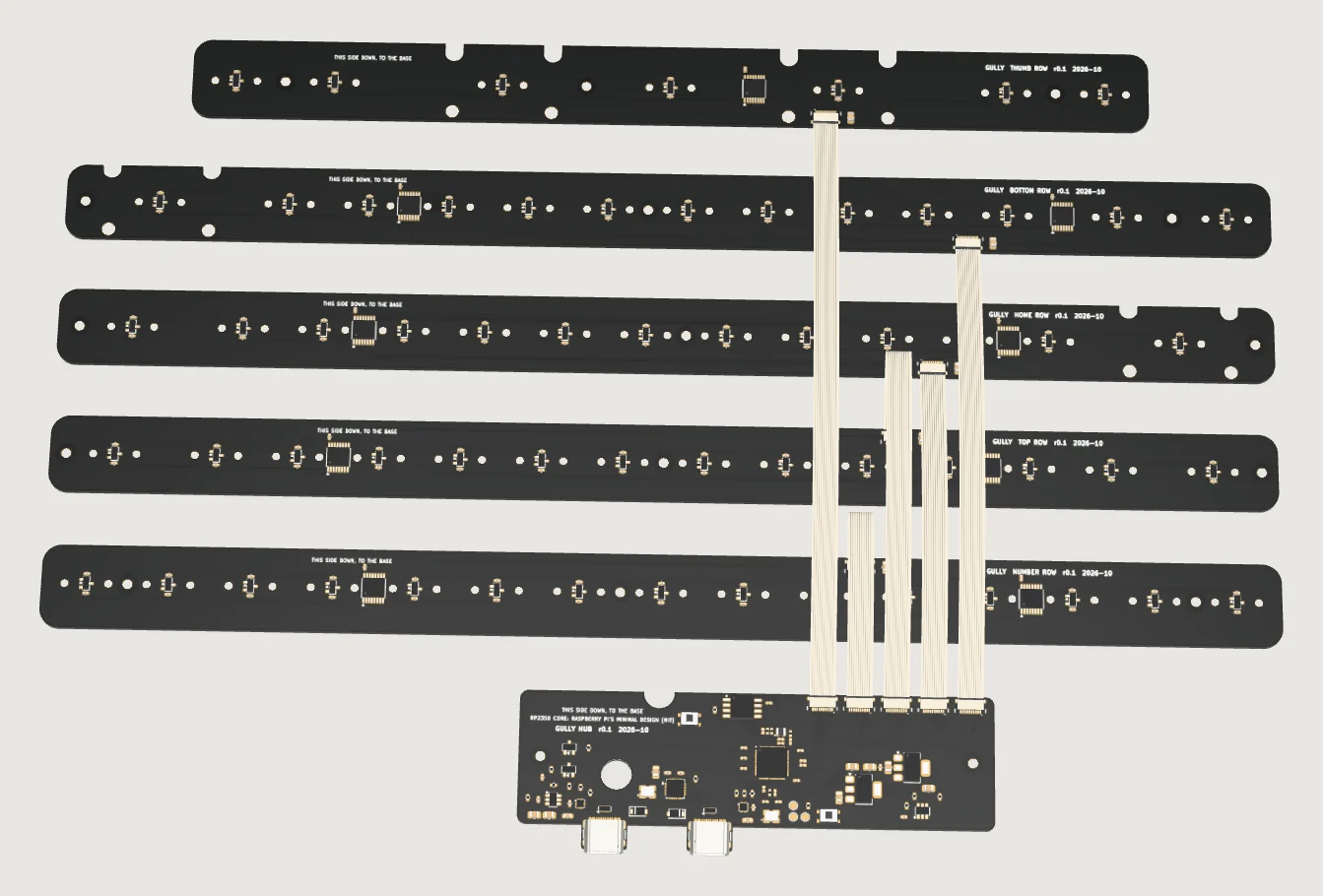
Take the brass off, and it's six boards.
A strip for each row, and a hub across the back. Every part sits on the side that faces the base, so each Hall sensor reads up through the board at the magnet in its switch.
- The rows
62 sensors, each dead under its key, read down a single line by one or two muxes.
- The hub
An RP2350A reads every key nearly 4,000 times a second, beside a USB hub and both sockets.
- Nothing to solder
The factory places all 295 parts. Five flat cables clip in, and the switches push in from the top.
All six are drawn and checked. None has been made yet.
06 · The caps
Dvorak, in huge type.
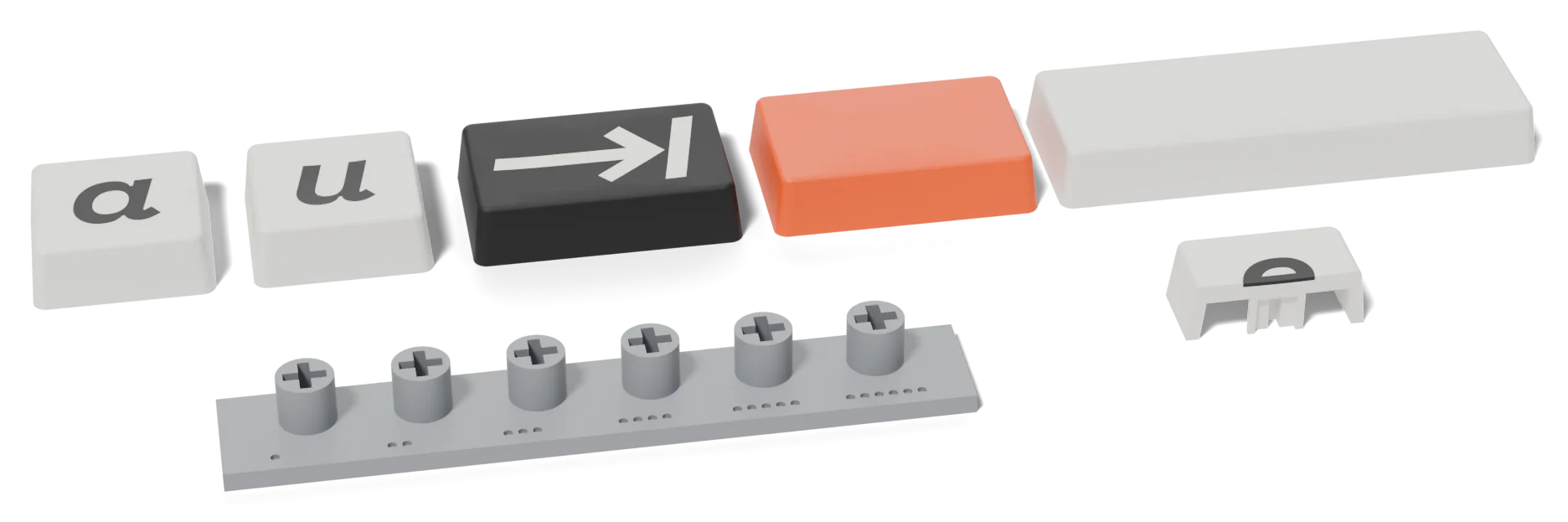
With the bed doing the sculpting, a whole set is one shape in five widths, so the caps can be our own: printed in resin, in the house's paper, ink and orange. Each legend is cut in and filled with ink, so it can't wear off, set in Space Mono Bold Italic, 13.8 mm tall on a flat, square top. The black keys get one big mark each, filled with paper and drawn to the letters' weight and slant.
aoeuidhtns
07 · Specifications
The numbers.
| Size | 305 × 115 mm; 18 mm tall at the front and 33 at the back |
|---|---|
| Weight | About 1.9 kg, 875 g of it the brass base |
| Layout | HHKB, 62 keys, the space split 2.75 + 1.5 + 2.75; Dvorak |
| Key bed | Five rows at 1°, 4°, 7°, 10° and 13° to the desk, each key square to its own row |
| Switches | Hall effect, MX stems: Wooting Lekker, Gateron magnetic, Glorious Panda HE and the like |
| Sensing | A Hall sensor under every key, reading up through 1.6 mm of board; every key read at nearly 4 kHz |
| Boards | Six two-layer boards, a hub and five rows, joined by five flat cables; 295 parts, all on the underside and all placed at the factory |
| Body | 6061-T6 aluminium, three-axis CNC machined, bead-blasted, clear anodised |
| Plate | 1.5 mm 5052 aluminium, laser-cut and bent four times, black anodised, on a Poron gasket |
| Base | 3 mm brass, a 0.5 mm shadow line at the foot; six feet over five screws |
| Caps | Printed resin, one square tile shape 6.4 mm tall; paper, ink and one orange |
| Legends | Dvorak, in Space Mono Bold Italic, 13.8 mm, cut 0.4 mm deep and filled; a drawn mark on each black key |
| USB | USB-C in from the computer and one USB-C out through a built-in hub, in slots 9.5 × 3.8 mm, sockets 0.2 mm inside the wall so any plug seats. The out port needs a USB-C host offering 1.5 A |
| Brain | RP2350A, polling at 1 kHz over USB, with open firmware (libhmk, to be ported): per-key actuation, rapid trigger, tap-hold |
| Status | Concept: the case, caps and boards drawn and checked. Nothing made, and the firmware not started |