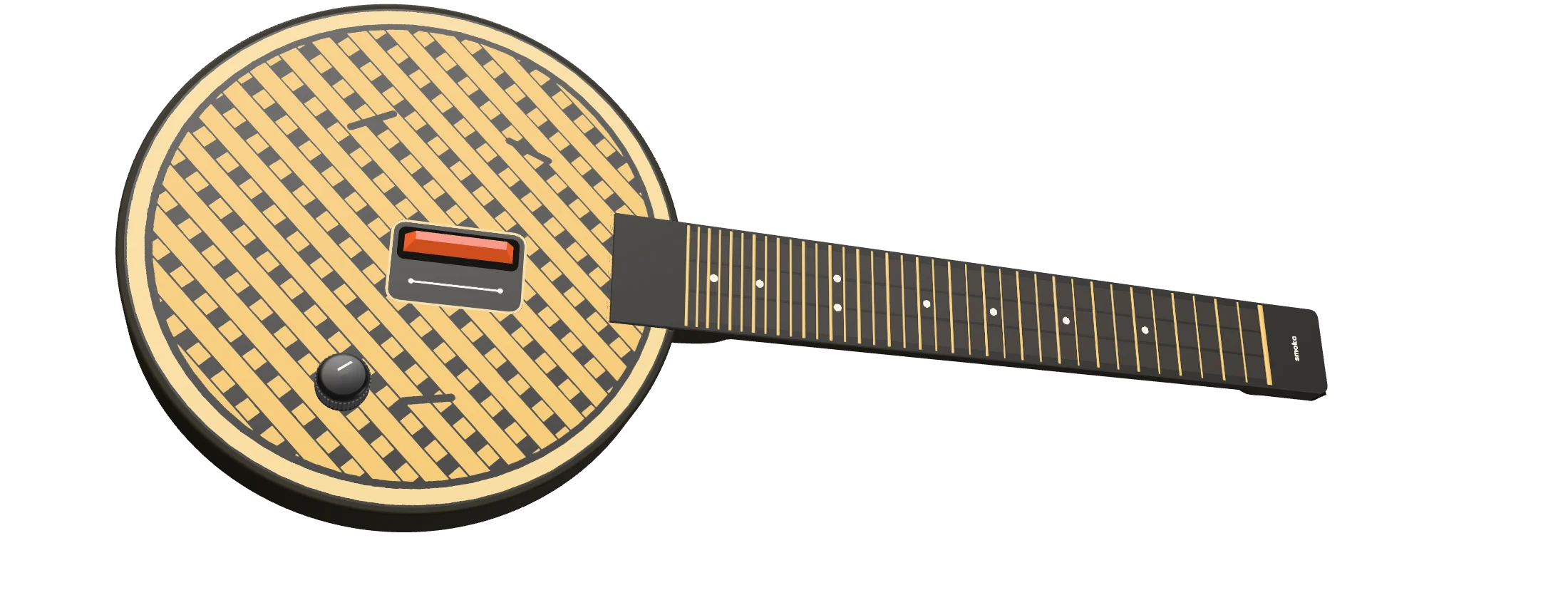
A desk instrument · three strings, 24 frets to the octave · 538 × 229 mm
The quarter-tone guitar for smoko.
Its frets are a quarter tone apart, so it plays the notes between a guitar's notes as well as the ones you know. Every string has a pad at every fret, so you play notes and real chord shapes, not chord buttons. Strum the orange bar, bend on the line below it, and hear it in your headphones. Or play your computer over MPE, quarter tones and all.
01 · The fretboard
Every note, and the notes between.
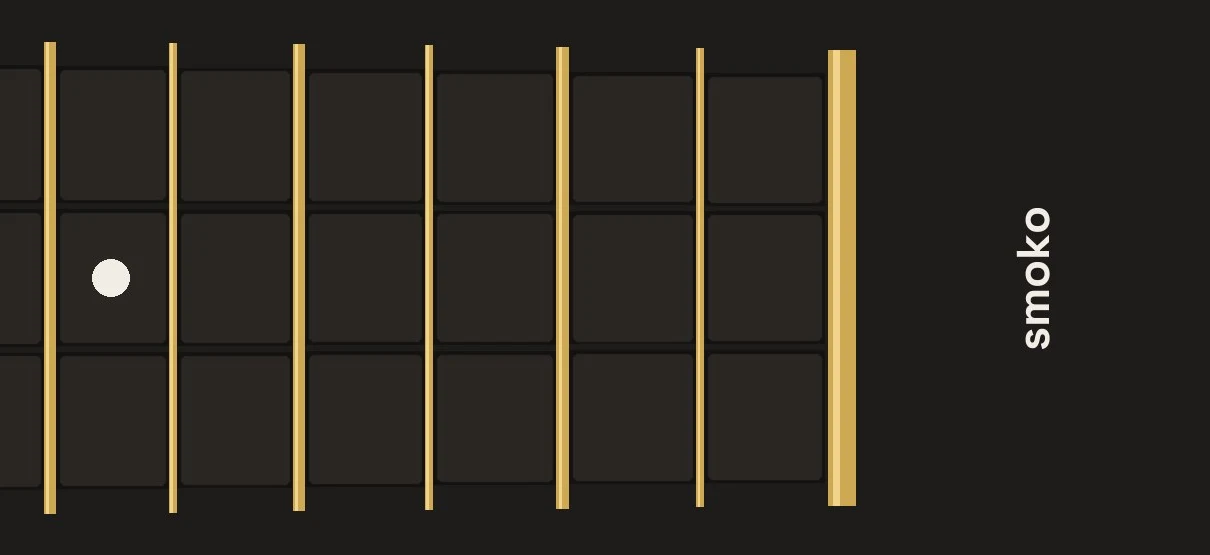
The fretboard is a circuit board. Under its black face are 108 copper pads, three strings by 36 frets, with gold frets between them. Each pad is one string at one fret, so you play single notes, slides and real chord shapes, as on a guitar, not a button for a whole chord. The frets are a quarter tone apart, 24 to the octave, as on King Gizzard's microtonal guitars. There are no strings to tune, no tension and no wear.
The wide gold lines are the semitones, where a 433 mm string would stop (a tenor ukulele's scale, so chord shapes are a guitar's); the thin ones between are the quarter tones. Eight small chips, four at each end of the neck, read every pad about a thousand times a second.
02 · Tunings
Every fret's pitch is a number.
Nothing on the neck decides a note: the RP2350 does. The frets are quarter tones, so play every other one for a guitar's semitones, or all of them for the notes between.
- StandardEvery other fret: the top three strings of a guitar, G, B and E, and every shape you know.
- OpenOpen G or D, the way a cigar-box guitar's tuned: one finger across a fret is a chord.
- Quarter tonesEvery fret, 24 to the octave, as on King Gizzard's microtonal guitars: the notes between the notes.
- Anything elseNineteen to the octave, just intonation, a bass: it's only numbers.
For six strings, the neck is its own board. The joint carries the lines a bigger neck needs, so another neck plugs into the same body.
03 · The face
A pie, and a face that swaps.
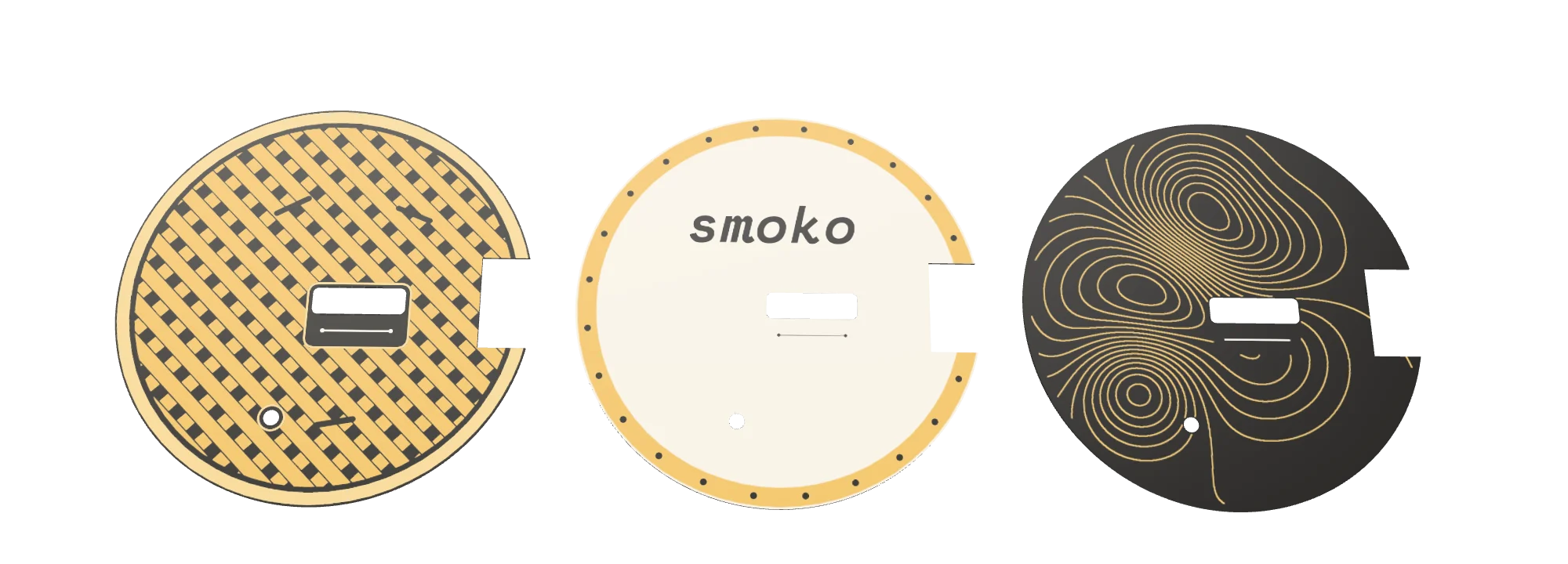
Smoko is shaped like a meat pie: a round black printed tray, its crust a smooth ring, and the neck for a handle. Its face is a circuit board, black or white solder mask with gold showing through. It sits inside the crust on eight magnets. Pull off the knob, lift the face out by the scoop in the crust, and drop another one in.
The artwork is only copper, mask and silk, so a new face is just another board. There are three to start: a pie's lattice, a banjo's head and a contour map. Every face has the same slot for the bar, hole for the volume and notch for the neck. The whammy reads through the board, so no face has copper over its line.
04 · Strum, bend, turn
A Guitar Hero bar, and a whammy you touch.
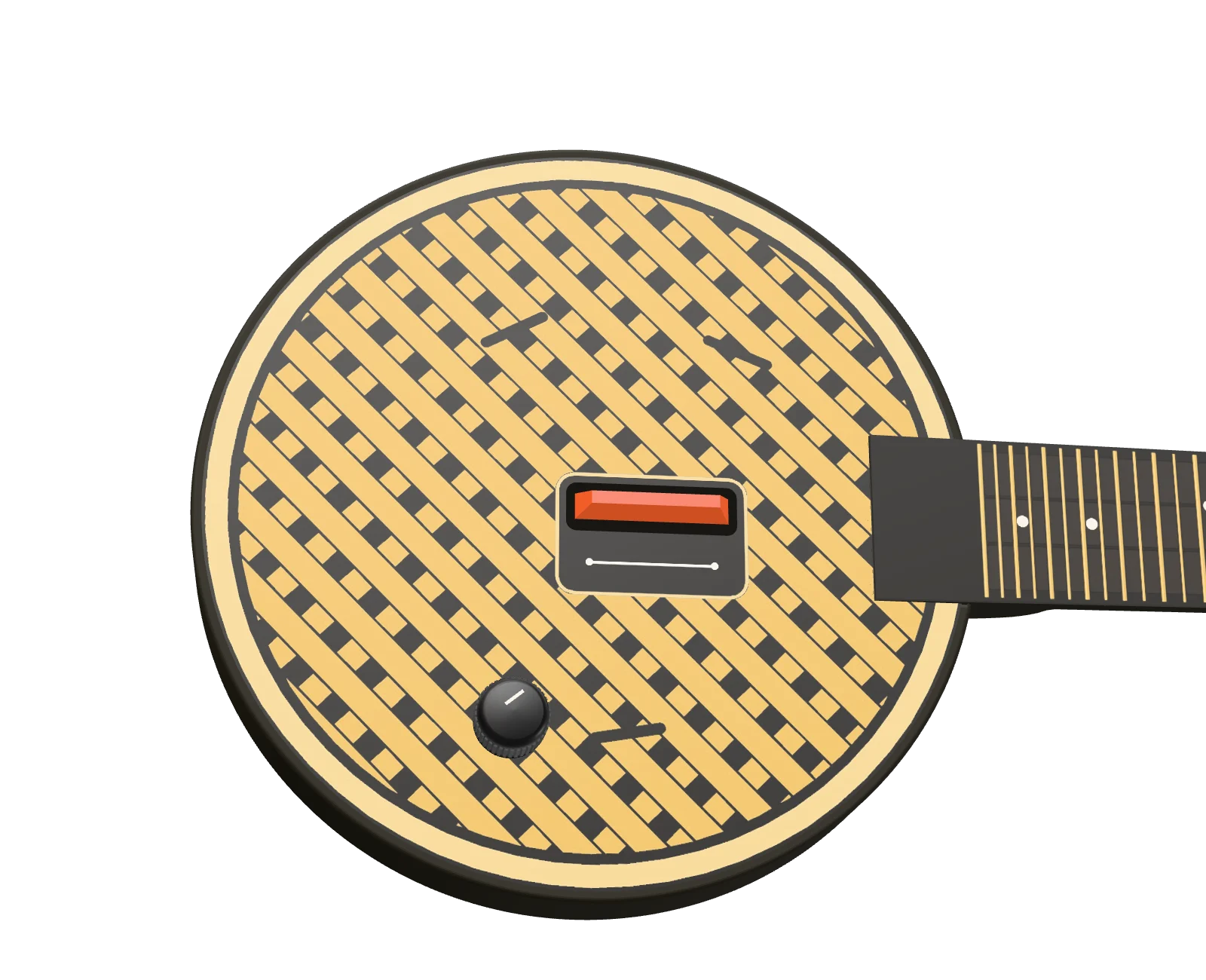
The strum bar lies along the strings, as Guitar Hero's does: a slim printed keel that rocks onto a Cherry MX switch each way. You feel the click, and the timing's yours. The switches push into hot-swap sockets, so the click is yours to choose, and their springs centre the bar. It clicks about eleven degrees over, and lands on a stop at seventeen. A magnet in it turns past a Hall sensor, which tells which way you hit it and how hard.
The whammy is the white line below the bar: two copper wedges just under the face, read through it the way the frets are. Slide along it to bend, and lift your finger to let go. The one knob is the volume, and that's all there is on the face: no buttons. Voices and tunings are to be picked on the neck: hold the strip and touch a fret.
05 · Sound
Its own voice, or MPE.
A codec in the body plays into headphones, so you can pick it up at smoko and play it without bothering anyone. Its voices are plucked strings, each worked out the way a real string rings, in tune to a cent or two on every quarter tone. Five so far.
- Quarter tonesA phrase on G that leans on the notes between the frets, then a slide up through them, on Saz and then Steel. 38 s
- StrumDown and up on Pie tin, through G, C, D and a C with its third a quarter tone flat. 25 s
- WhammyA chord on Electric, dipped a quarter tone, shaken, let go, then dived a whole tone. 23 s
- Pie tinA pie-tin banjo: bright, twangy, gone quickly. 10 s
- NylonWarm and soft, and it rings on. 10 s
- SteelA picked steel-string acoustic, bright in a boxy body. 10 s
- SazThin and nasal, its strings in pairs that shimmer over a buzzing bridge. Quarter tones are at home on a saz. 10 s
- ElectricLong, bright strings through a pickup and a little drive. 10 s
These were played from a score through its own sound engine, the code that will run inside it, on a computer, before there's a guitar to play them on.
Plug in the USB-C and it's power, MIDI and a sound card in one cable. It speaks MPE: every note goes out on a channel of its own with its own pitch bend, so your computer's instruments play the quarter tones exactly, and the whammy bends what you're holding. For anything that doesn't know MPE, there's plain MIDI in semitones. MIDI out on a 3.5 mm jack sends the same to a synth with no computer at all, and a standard adapter makes it a five-pin DIN.
06 · Inside
Lift the face, and it's all there.
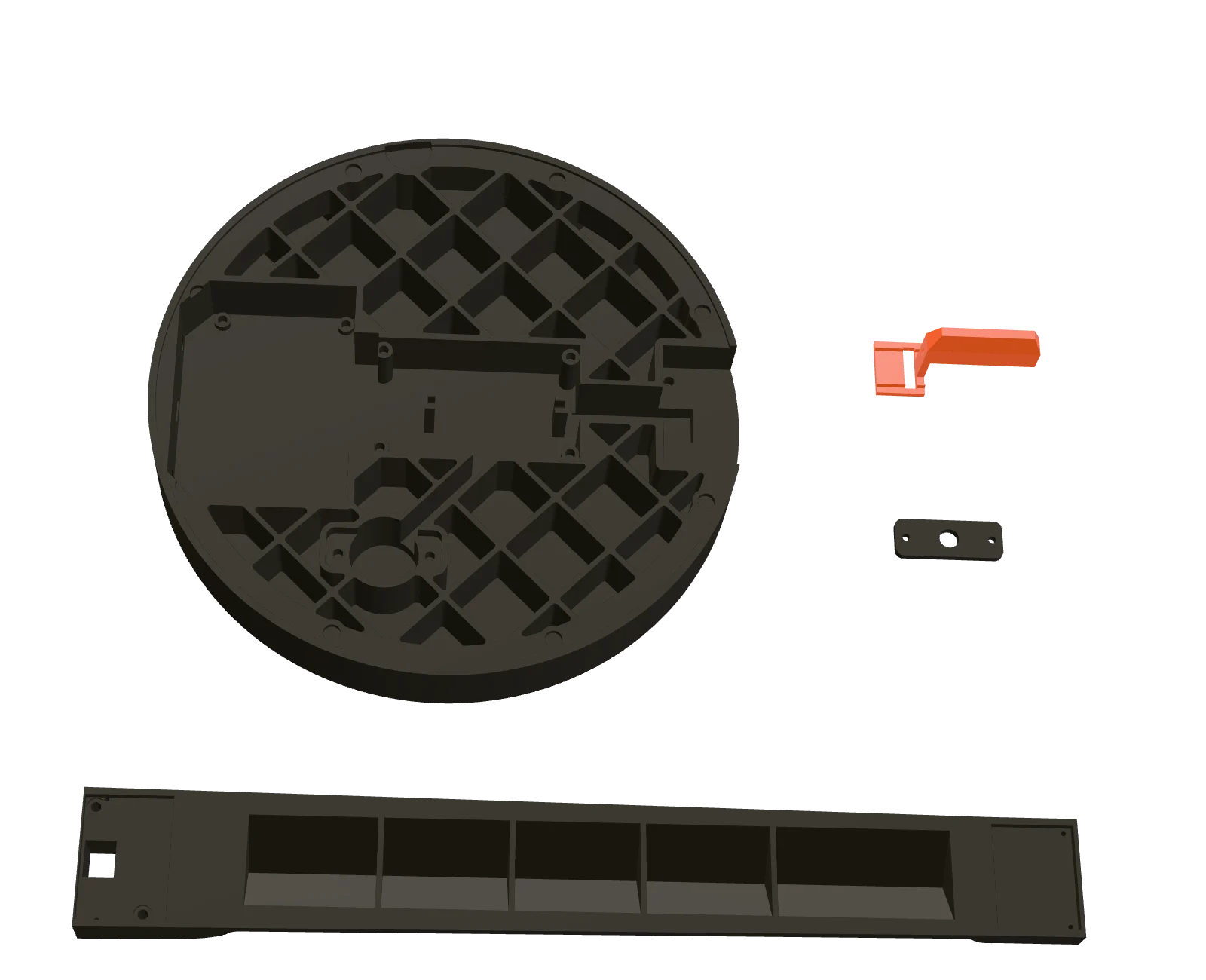
The tray is printed in one piece, and everything goes in from the top. The brain sits across the tail on four posts, its ports out through the crust. The strum board sits just under the face, with its switches hanging below it for the bar's tab. The volume drops into a well of its own and clamps to a little bridge across it, never to the face. Under the rest of the face is a lattice of ribs, a second pie inside the first, holding the face up. The back is one smooth piece with no screws. The neck is a third board on a printed spine, hollowed the same way.
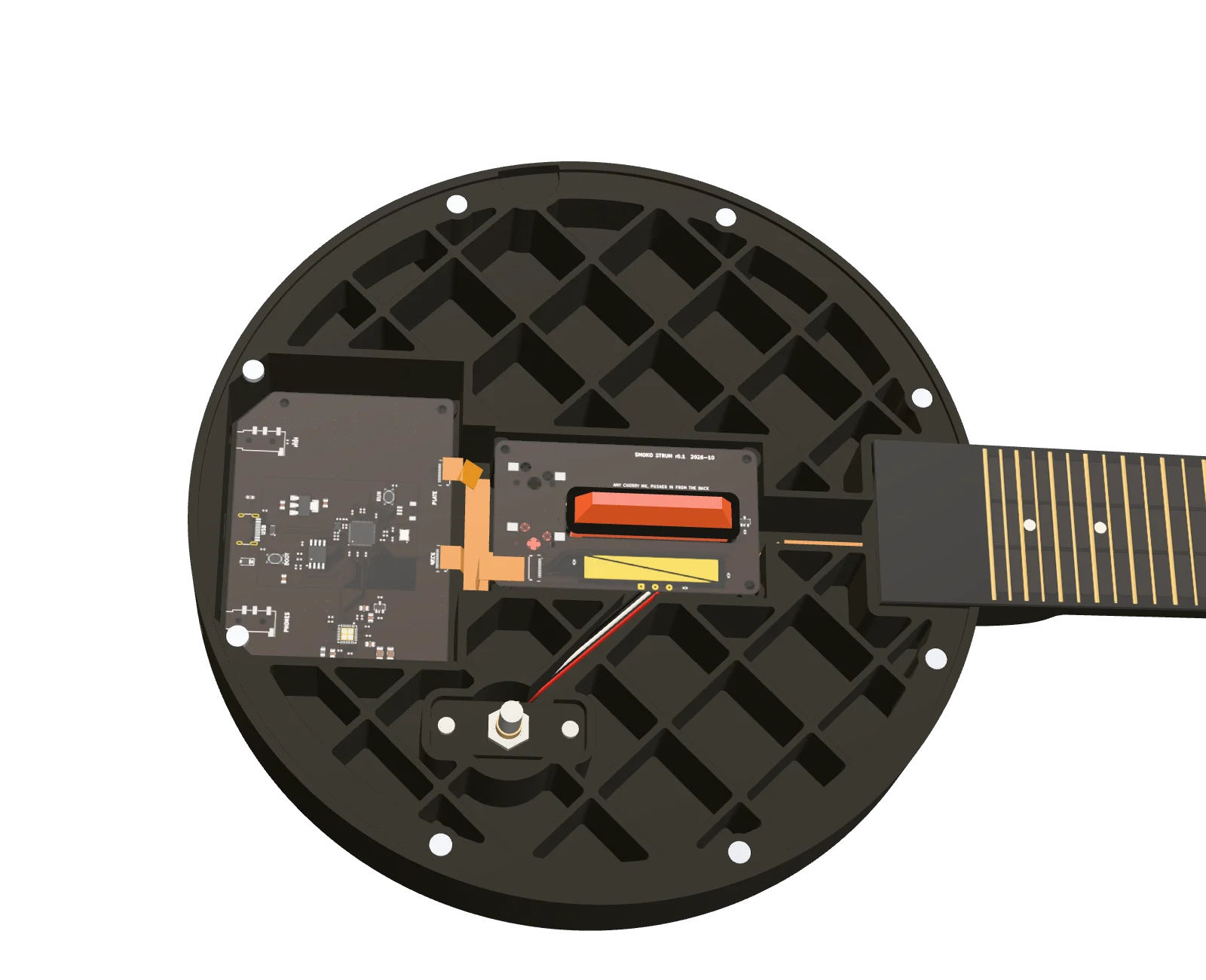
The brain is a Raspberry Pi RP2350 on a board 88 × 64 mm, laid out as Raspberry Pi lay it out. The strum board and the neck only sense, so another neck needs no new brain. And as with the slab, the firmware's yours to rewrite.
07 · Specifications
The numbers.
| Size | 533 × 220 mm; the body 30 mm deep, the neck 48 mm wide at the body and 42 at the nut |
|---|---|
| Fretboard | A circuit board: 108 capacitive touch pads, played note by note, 3 strings × 36 quarter-tone frets (24 to the octave, an octave and a half) at a 433 mm scale, read by eight 16-way multiplexers in two banks; gold frets and nut, the quarter tones thinner; white dots on the semitones at 3, 5, 7, 9, 12 and 15, 17 |
| Face | A circuit board 214 mm across and 1.6 mm thick, black or white with gold and silk. It sits on eight magnets in the crust and swaps. Three to start: Pie, Banjo, Map |
| Body | A tray 3D-printed in one piece, in black, its crust a smooth circle 220 mm across, 30 mm deep. It's hollowed under the face into a lattice of ribs, and a printed spine runs under the neck. Hidden in the tray are two circuit boards: the strum board (76 × 46 mm) under the face and the brain (88 × 64 mm) at the tail |
| Brain | Raspberry Pi RP2350, after their own minimal design; hackable: the Pico SDK, Arduino or MicroPython |
| Play | Strum bar, printed, along the strings on two Cherry MX switches in Kailh hot-swap sockets (any MX will do), with a Hall sensor for how hard; whammy, a touch strip read through the face; volume. No buttons |
| Sound | TI TLV320AIC3100 codec into headphones on a 3.5 mm jack, and USB audio. Five voices of modelled plucked strings: Pie tin, Nylon, Steel, Saz, Electric |
| MIDI | MPE over USB and out on a 3.5 mm jack (TRS type A): a channel and a pitch bend for every note, so the quarter tones arrive exact. Plain MIDI in semitones too |
| Power | USB-C: power, MIDI and USB audio on one cable |
| Tunings | In firmware: standard and open on every other fret, quarter tones on all of them, any steps you like. A six-string neck could plug into the same body |
| Catches | The touch sensing is drawn, not proven: it needs a board on the bench. The faces are drawn as artwork so far. The brain now lies parts up, which mirrors its connectors, so its strum cable crosses the neck's; its next revision swaps them. The knob has to come off before the face can. The whammy reads through the face and an air gap, which may be too far: its pads may have to move onto the face itself |
| Status | Concept. The fretboard and the strum board are drawn; the brain is drawn but for one line; the prints are modelled, the strum bar swung through its travel in 3D. The voices are written and heard above; the touch scan and MPE are planned, not written |